Hettie Judah ‘ How To Enter The Art World After…’
An afternoon with writer and curator, Hettie Judah, author of How to Enter the Art World After… with four artists’ talks about their work
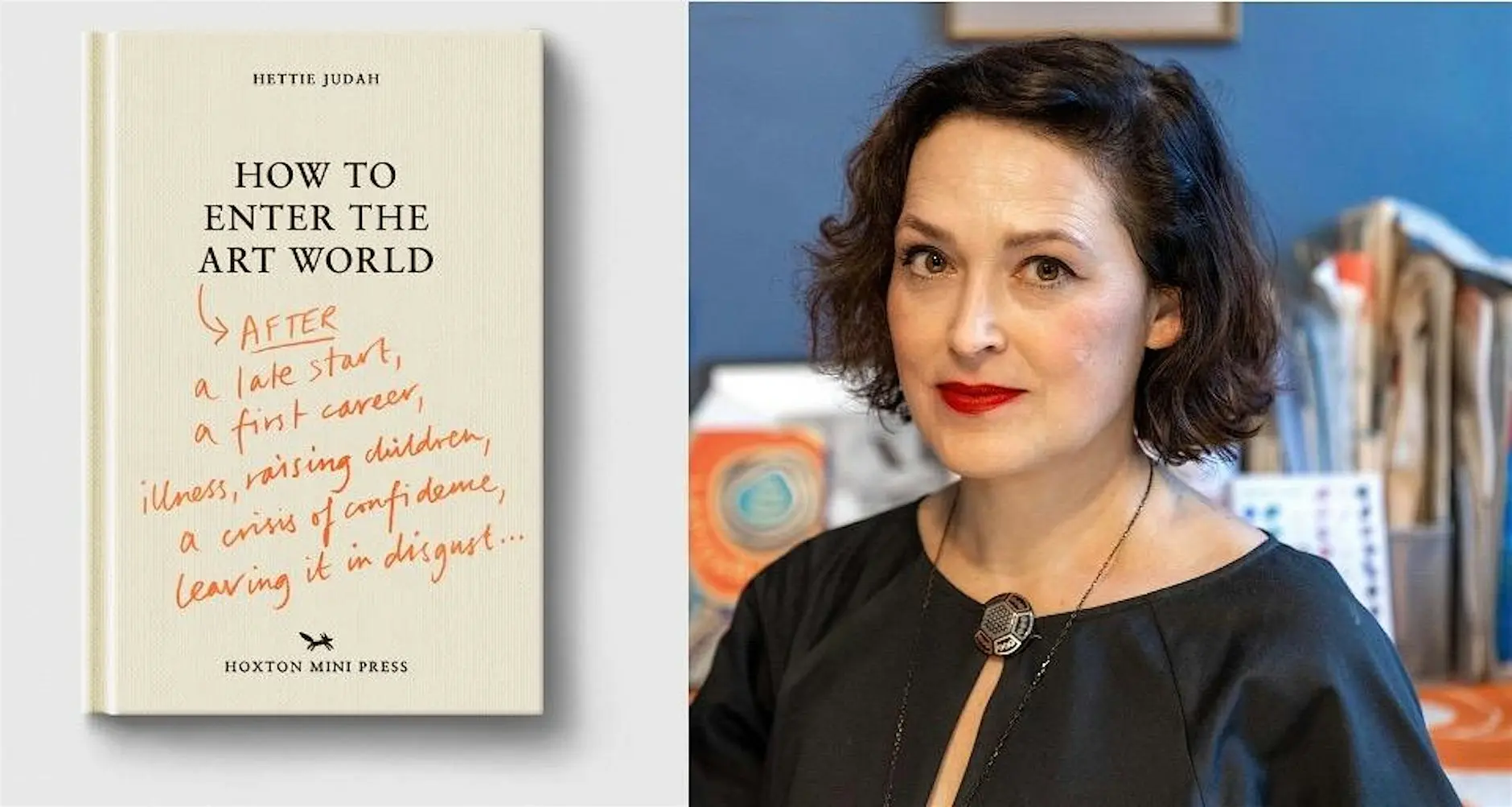
Join us on Sunday 24 May at 2pm for an afternoon with writer and curator, Hettie Judah, as we launch her new book, How to Enter the Art World After… a late start, a first career, illness, raising children, a crisis of confidence, leaving it in disgust…
There will be presentations by artists from the Purbeck art community – Debbie Lee, Elizabeth Brown, Sharon James and Jane Colquhoun – followed by an hour-long discussion and Q&A with writer and curator, Hettie Judah, followed by a book signing and informal conversations.
How to Enter the Art World After is a grown-up guide for any artist whose life is complicated, demanding and, well, human. Informed by years spent working with artists and dozens of candid interviews, it is a myth-busting bonanza full of insights, ideas and inspiration. Can you make it without going to art school? Can you get back into the art world after years away? And what does success actually mean? Frank, funny and occasionally forthright, this is your friend on the path (back) into the art world.
The afternooon will begin with four short presentations by artists – Debbie Lee, Elizabeth Brown, Sharon James and Jane Colquhoun– who will share some of their recent work, current projects and ideas. These presentations will be followed by a relaxed hour-long Q&A with Hettie. We will be seated in the marquee, and everyone ( audience and artists) is invited to participate (an all-Q&A format developed by the artist Ghislaine Leung, who features in the book). Together, the event will move between individual practices and shared discussion, reflecting on how artists navigate entry, re-entry and continuity within the art world.
At the end of the session there will be an opportunity for conversation between participants, and a book signing with Hettie, with How to Enter the Art World After available for purchase. Catering and a bar will be open throughout the event.
About the event contributors:
Hettie Judah is a writer and curator. She is a regular contributor to The Guardian, Frieze and The Times Literary Supplement, and writes a monthly column for Apollo magazine. Her writing on art can also be found in Art Quarterly, Art Monthly, ArtReview and other publications with ‘art’ in the title. Between 2016 and 2024 she was the chief art critic for the British daily newspaper The i. Hettie curated the Hayward Gallery Touring exhibition Acts of Creation: On Art and Motherhood which toured venues in the UK between 2024 and 2025, before transferring to VISUAL in Ireland, where it ran until early 2026. The standalone book Acts of Creation: On Art and Motherhood is published by Thames & Hudson. Following publication of her 2020 study on the impact of motherhood on artists’ careers, in 2021 she worked with a group of artists to draw up the manifesto How Not To Exclude Artist Parents, now available in 16 languages. She regularly talks about art and with artists for colleges, as well as museum and gallery events. A supporter of Arts Emergency she has mentored artists and students through a variety of different schemes. Recent books include Tracey Emin (Tate, 2026), How Not To Exclude Artist Mothers (and other parents) (Lund Humphries, 2022) and How to Enter the Art World…After will be published by Hoxton Mini Press in April 2026. She is currently working on a major book on art and women’s desire, to be published by Thames & Hudson in autumn 2027.
Debbie Lee
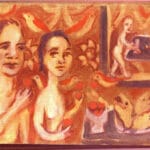
Debbie Lee is a visual artist exploring storytelling and personal narratives.
Debbie studied painting in Glasgow School of Art and at the Royal College of Art. She went onto study in Chicago and did a residency in Hobart she also travelled on a Commonwealth scholarship to India to study narrative scrolls and glass painting. Her first solo exhibition in London was called Storytelling at Southwark Park Gallery (2002). In 2007 she moved to Dorset to raise a young family. She has taken part in projects which help to find the balance between art-making and parenting such as Project After Birth, and the Brood Film Festival with the Digital Institute of Early Parenting. Finding a supportive network was important to herdevelopment as an artist. In 2023 she was elected to be a Royal West of England Academician. She was a steward for the Artist General Benevolent Institute for the last 2 years which supports artists in need. In 2024 she had a solo exhibition called Storybound at the Slade Centre in Gillingham and this year she was commissioned to be the headline artist in Dorset Arts Weeks with a narrative river project called FLOW at Bere Marsh Farm.
Elizabeth Brown
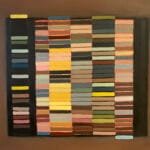
Using just colour to investigate the landscape liberates both it and the artist, and gives context and theory to these visual building blocks. This is the framework where Elizabeth Brown’s observations and thoughts are considered. During each trip across the Heathland of Middlebere, Hartland and Slepe, so drenched in shifting colour and weather variations, her overwhelming focus became to eliminate form to advance this meaningful experience.Having received the Andrew Cole Emerging Art Prize at the 172nd Open exhibition at The Royal Academy of Arts in Bristol, her attention was primarily as colour responses to the heath. Managed by The National Trust and other bodies, areas are being cleared as a restoration project vital for the heath’s biodiversity. With these subtle alterations happening, Elizabeth feels a refining process ,too ,will follow in her painting as her response to these changes.Her work was also selected for; DVA ‘In our Nature” May 2025 The Fine Foundation Gallery – Durlston Country Park. The Dorset Open Oct 2025 – Dorchester Museum & Art Gallery.The Moorwood Art 2025 Group Autumn Exhibition – The Moorwood Gallery. The Sandy Hill Arts Open Exhibition 2026. She is excited to be showing her work at Sandy Hill Arts during Purbeck Art Weeks, and Dorset Art Weeks for her solo exhibition in June. She welcomes seeing the many visitors who have been to her studio in the past and invites them to call in and see her developing ideas and new works.
Sharon James
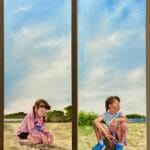
Sharon James is an artist and printmaker based in Swanage, Dorset, working across oil painting, drawing, and printmaking. Her practice explores personal and collective histories, with a focus on motherhood, heritage, and the Black British experience. She is particularly interested in how identity and ancestry shape our stories and how those narratives evolve across generations. Her work has been predominantly figurative, often rooted in portraiture and storytelling. However, she also produces abstract pieces almost as an antidote to the rigorous nature of representational painting. These works provide a space for intuitive mark-making and emotional release, allowing a different kind of freedom within her practice. Her recent solo exhibitions #Artistmother, The Art of Motherhood, and A Mother’s Legacy have delved into the intersections of family, culture, and creativity. She uses layered, symbolic imagery to create compositions that invite viewers to reflect on their own connections to family and place.
Jane Colquhoun
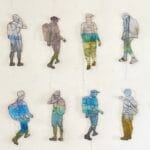
Jane Colquhoun works with snips of leftover fabric and thread—‘orts’—layered and bound together with stitch to form tiny, quilted forms. Using fragments gathered from her domestic environment alongside printed and prepared elements, she pieces together collections that blur autobiography and fiction. Arrays of figures evoke the shape of community—her maternal line, female friends, strangers observed from a distance, and aspects of her own identity. Fabric motifs and scraps of text transform them into surreal beings: flower maidens, mermaids, dancing queens, or goddesses—celebrations of kinship, nature, and shared histories. Other forms include textile houses that emerge as imagined dwellings—castle, garret, or hut—approached not simply as shelter but as psychological and poetic space. The house becomes an extension of the body: a site of memory, dreaming, safety, and retreat, yet also of habit, restriction, and containment. This work developed following the loss of Jane’s mother and a period of focused reflection, when her practice turned inward. Themes of belonging, identity, and loss became central, and narrative regained significance as she sought connection with family histories and folklore. Presented as collections, each form acts as a personal archive—assembled from remnants, holding emotional and symbolic resonance. Together, these stitched forms trace an interior landscape where home and community are continually gathered, preserved, and reimagined.
We look forward to welcoming you to Sandy Hill Arts for a fascinating afternoon of presentations and discussions focussed on career journeys in the art world-we are delighted to be hosting such a wonderful event during Purbeck Art Weeks and Dorset Art Weeks.